Your AI Feature Shipped. Now, Will Users Trust It?
The question product and engineering teams ask before shipping an AI feature is usually simple: does it work? Is the model accurate enough? Are the outputs reasonable?

These are necessary questions. But they are not enough.
Usability in AI products is not only a performance problem. It is also a problem of trust, transparency, and user control. And trust is not something you can read from a model accuracy report.
When AI becomes part of everyday digital products like search, document summaries, payment flows, support chatbots, and recommendation engines, the user experience changes.
It is no longer enough for an experience to work or be easy to use.
It becomes about whether users believe the system, feel in control of it, and know what to do when it gets something wrong. Those are UX and design questions that model performance alone cannot answer.
This article walks through the psychology behind AI trust, the design levers that shape it, and why teams cannot validate any of it without testing with real users.
Users Hold AI to a Different Standard
Acquire BPO's 2024 AI in Customer Service Survey polled 600 U.S. consumers and found that 70 percent would consider switching brands after one frustrating encounter with AI-powered support.
Verint's State of Customer Experience 2025 report, based on 5,000 U.S. consumers, put that number at 78 percent, up from 67 percent the year before.
That is the margin product teams are working with. Users do not judge AI the way they judge other software. Five dynamics explain why.
1. Expectation Confirmation Theory
Users feel satisfied when an experience matches what they expected. They feel frustrated when it does not, even if the system performs well on technical benchmarks.
If users expect an AI assistant to understand context like a human, any shortfall feels like failure. The model's accuracy does not matter if the experience fails to meet expectations.
2. Overreliance on AI
Users may over-rely on AI outputs, particularly when the system appears confident, authoritative, or consistently accurate. That becomes a problem when an error appears.
If users assume the AI wouldn't make mistakes, they may not check its work. Then, if something goes wrong, the failure feels larger, and the trust damage runs deeper than it would with any other software. Users may forgive a human mistake, but an AI mistake can make them question whether the system can be trusted at all
3. Algorithmic Aversion
Users empathize with human errors, but they treat AI errors as warning signs.
Research published in 2025 confirmed that people often drop trust in AI after one visible mistake, even when that AI performs better than humans overall.
Users don't always hold humans and AI to the same standard. Product teams need to account for that difference.
4. Mental Models
Users bring assumptions from tools they already use. If they have used conversational AI, they expect AI to handle ambiguity, context, and tone in familiar ways.
When your product diverges from those existing mental models, users have to work harder to understand how it behaves. That added effort can lead to confusion, mistakes, or a loss of confidence in the product.
5. Human AI Collaboration Expectations
Most users see AI as a tool to support their judgment, not replace it.
When companies market AI as a replacement for human judgment, users become less forgiving when it falls short. The framing sets the stakes.
Bad AI experiences cost trust. Small errors chip away at it. Bigger mistakes can break it entirely. Once trust is gone, it is hard to regain, especially when the system feels like a black box.
As Nielsen Norman Group's State of UX 2026 noted, people burned by AI features are more hesitant to adopt new ones.
Rebuilding confidence requires transparency, control, consistency, and meaningful support when things go wrong.
The Design Choices That Build Trust
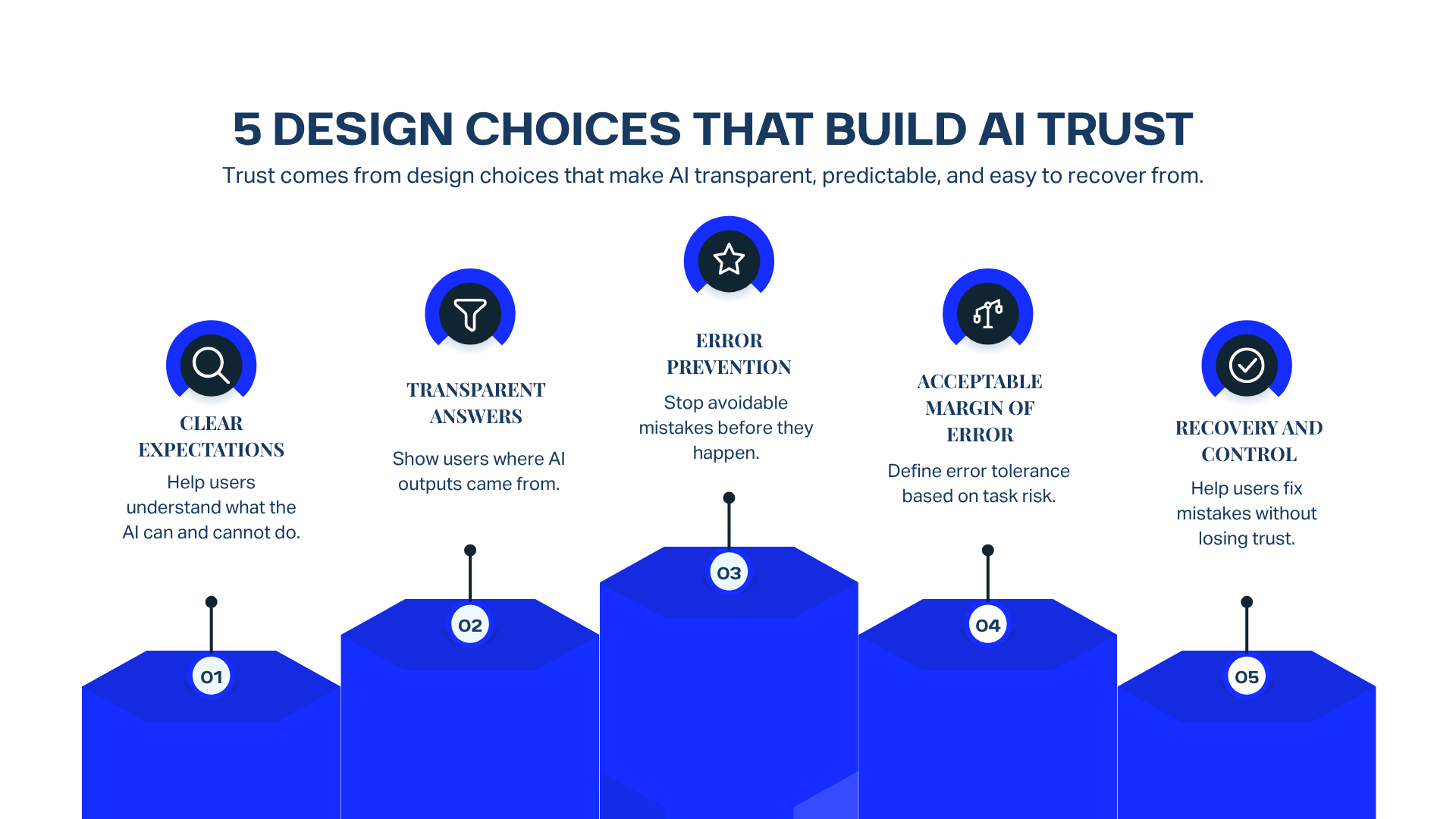
Model accuracy is the floor, not the ceiling. What separates an AI feature users trust and can rely on from one they might abandon is a set of deliberate design choices.
Set Clear Expectations
Good usability in AI products starts with clear expectations. Users are more forgiving when they understand what a feature can and cannot do.
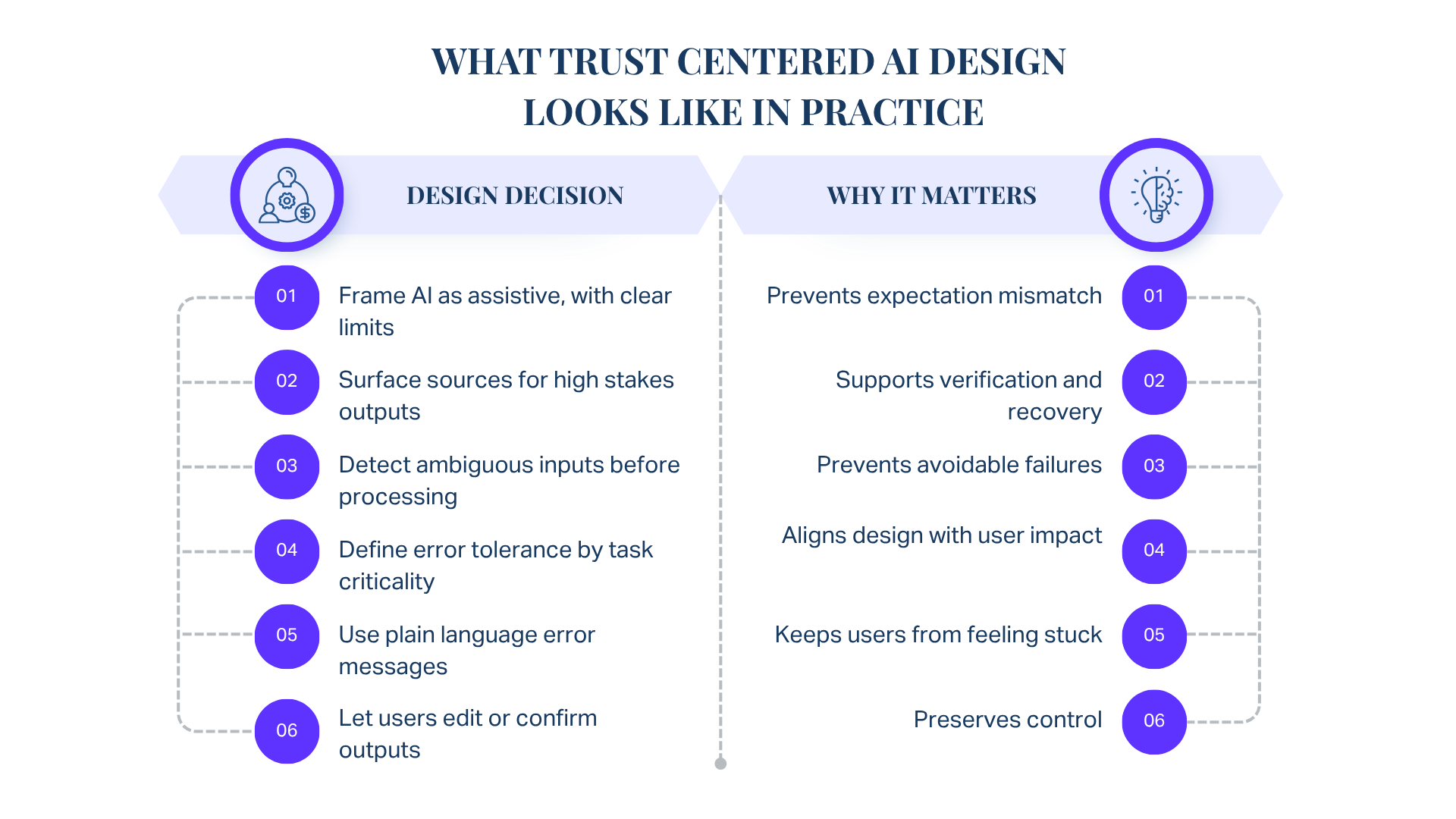
Frame the feature as assistive, with clear capabilities and limits. “I can help you summarize documents in English” is stronger than “I can answer anything” because it sets a realistic boundary.
Use onboarding flows or contextual tooltips to align users’ mental models before they hit an edge case. Make it clear where the AI’s authority ends and where human judgment still applies.
Show Users Where the Answer Came From
When users need to evaluate the accuracy or credibility of an AI-generated output, make its supporting sources or evidence easy to inspect.
Nielsen Norman Group’s research on explainable AI shows that users may trust unexplained chatbot outputs automatically, even when they should not.
Inline citations, linked references, and source previews help users check the AI’s work without leaving the experience.
This matters most for high-stakes outputs such as research summaries, financial recommendations, legal document analysis, medical guidance, insurance decisions, payment flows, and fraud decisions.
Sourcing also gives users a recovery path. When the AI is wrong, they can trace the error back to its origin.
Prevent Errors Before They Happen
Nielsen’s Heuristic #5, error prevention, applies directly to AI. AI errors can feel personal and unpredictable, so preventive design is better than reactive error handling.
Useful patterns include:
- Detect ambiguous inputs before proceeding
- Ask clarifying questions, such as “Did you mean X or Y?”
- Offer predictive text or suggested actions
- Surface invalid or unsupported commands in real time
- Let users self-correct before they hit a dead end
Define and Adapt the Acceptable Margin of Error
An acceptable error rate cannot be defined by a technical benchmark alone. It depends on the task, the consequences of failure, users’ ability to detect the error, and whether they can recover from it.
Mission-critical and noncritical tasks carry different tolerances. Errors involving payment amounts, medical guidance, or legal information carry far greater consequences and therefore demand much stronger safeguards
Suggesting an imprecise synonym in a writing tool has a much higher acceptable margin of error. Teams should refine acceptable margins based on real behavior:
- What errors do users recover from?
- What errors cause users to disengage?
- Which errors damage trust immediately?
- Which errors can be managed with better recovery design?
A system with strong error prevention, clear sourcing, user control, and recovery design can absorb more uncertainty than one without those features.
Help Users Recognize, Diagnose, and Recover From Errors
Nielsen's Heuristic #9, helping users recognize, diagnose, and recover from errors, is where most AI products visibly fail.
When the AI misses, explain what happened in plain language. Avoid error codes and vague messages.
When the system cannot resolve an input, offer actionable alternatives, such as: “I could not match ‘inspect’ with a known action. Did you mean ‘test’ or ‘review’?”
Always provide a constructive next step. Let users confirm or edit AI-generated outputs before action is taken.
This keeps users in control and reduces frustration when the AI gets something wrong, especially on noncritical tasks where error tolerance is higher.
You Cannot Design Trust Without Testing It.
AI is new, but user expectations are not. People still expect products to be easy, intuitive, and accurate. What has changed is the cost of falling short.
A confusing AI feature loses trust. Trust does not return just because the next release is better.
Product and engineering teams know how the system is supposed to work. That makes them poor judges of how it feels to someone using it for the first time. They fill in gaps that real users will not.
Surveys and NPS scores also have limits. These metrics capture what users say about trust, but behavioral research reveals whether those attitudes translate into actual use.
Users may say the AI feature is fine, then quietly stop using it. Observing real people interact with the product can reveal disconnects that self-reported measures alone may miss.
Usability testing is one of the most effective ways to understand whether users can appropriately trust, understand, and recover from an AI system in practice
- How often do users hit errors?
- What kinds of errors do they hit?
- Do users understand why an error happened?
- Does the system feel transparent or like a black box?
- Do recovery options help, or do users feel stuck?
- Where does the user's mental model break?
- Do users keep using the feature after a mistake?
These questions cannot be answered through internal testing alone. They require real users, real tasks, and a structured method for observing what happens when the experience does not go as designed.
That is what Testlio's usability testing service is built for.
Testlio is a fully managed crowdsourced testing company that connects product and engineering teams with global participants to help ensure every release works for every user, everywhere.
Testlio’s usability studies are designed, scoped, and managed by UX researchers who define the tasks, success criteria, and study structure.
Each study is conducted with participants who reflect the product’s ideal audience across geography, device, language, and usage behavior, so the user feedback maps directly to what real users of the product are saying in the real world.
This helps product teams see how their AI features work in real situations before problems appear in production.
The findings surface the issues that break trust:
- Mismatched expectations
- Confusing error states
- Opaque reasoning
- Weak recovery paths
- Overtrust in wrong outputs
- User hesitation after mistakes
These are the failure modes that NPS scores miss, and internal QA cannot catch.
The Question to Ask Before You Ship
AI usability isn't just about whether users trust a system. It's about whether they understand when to trust it, when to question it, and what to do when it gets something wrong.
Stop asking: "Is the model accurate enough to ship?"
Start asking: "Have we designed this so users know when to trust the AI, when to question it, and how to recover when it gets something wrong?”
That second question is harder to answer, but it can determine whether users come back. And answering it requires testing with real users in real-world scenarios.